
수동태와 능동태의 차이는 무엇인가요?
능동태는 주어가 행동을 직접 수행하는 구조(예: '연구진이 실험을 진행했다')이며, 수동태는 주어가 행동을 당하거나 받는 구조(예: '실험이 연구진에 의해 진행되었다')입니다.
과학 논문 등 특수한 목적 외에 일상적 글쓰기에서 수동태를 과도하게 사용하면 문장이 늘어지고 모호해집니다. 능동태는 글에 강력한 추진력과 선명함을 부여합니다.
능동태 문장을 써야 하는 이유 — Key Capabilities
전문적인 글쓰기를 돕는 능동태의 4가지 주요 이점입니다:
01직관적이고 매력적인 문체
행동의 주체가 명확히 드러나 글이 지루하지 않고 생동감이 넘칩니다.
02책임과 주체의 명료화
누가 결정을 내리고 행동했는지 모호함 없이 단번에 알 수 있습니다.
03단어 수 절감 및 간결화
불필요한 보조 용언이나 피동형 어미를 줄여 문장이 한결 가벼워집니다.
04스마트 행위자 감지
문맥상 주체가 생략된 수동태 문장에서도 적절한 행위자를 찾아 문장을 재구성합니다.
How to Use 수동태 능동태 변환기 (Passive to Active Voice) Step-by-Step
간단한 4단계를 통해 능동태 문장으로 전환하세요:
1. 텍스트 입력하기
변환할 문장이나 단락을 입력창에 입력합니다.
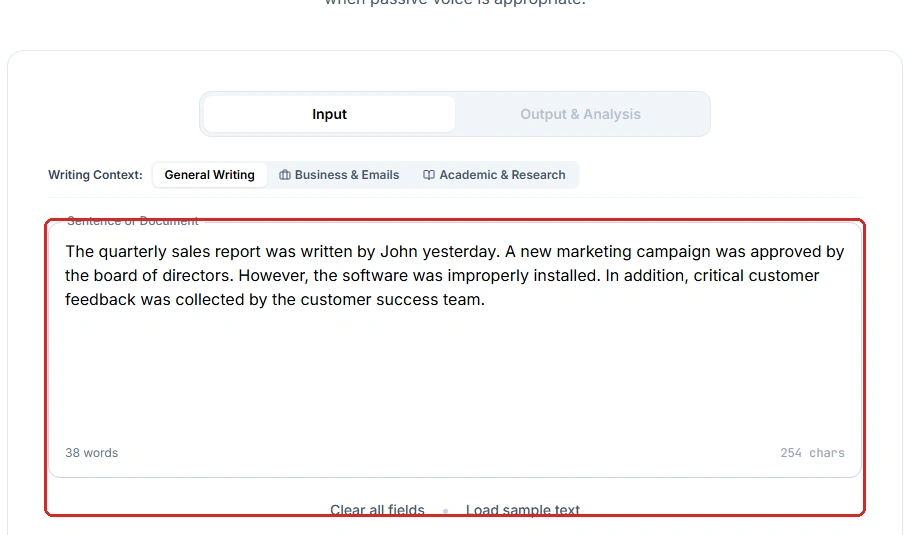
2. 문체 스타일 선택
글의 성격에 따라 일반, 학술, 비즈니스 스타일 중 하나를 선택합니다.
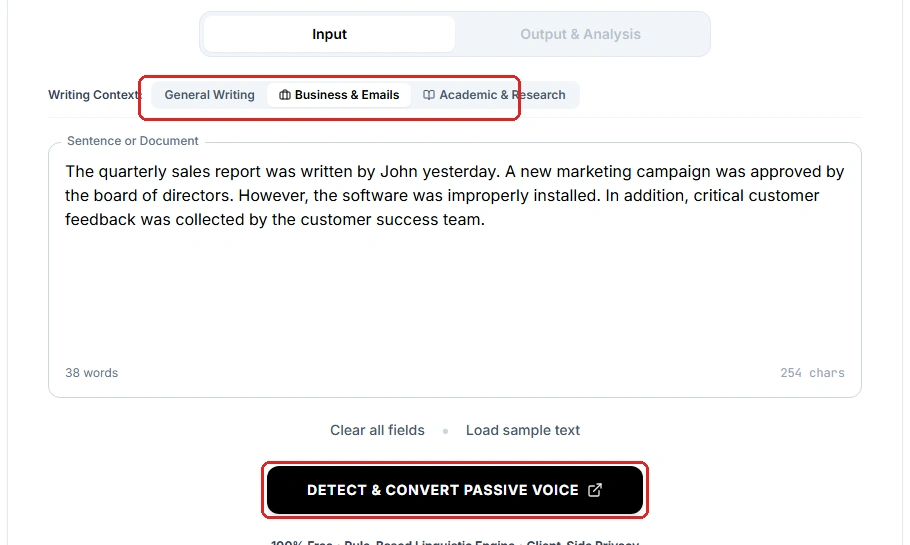
3. 능동태로 변환 클릭
도구가 피동 표현을 감지하여 주어-서술어 관계를 능동형으로 재배치합니다.
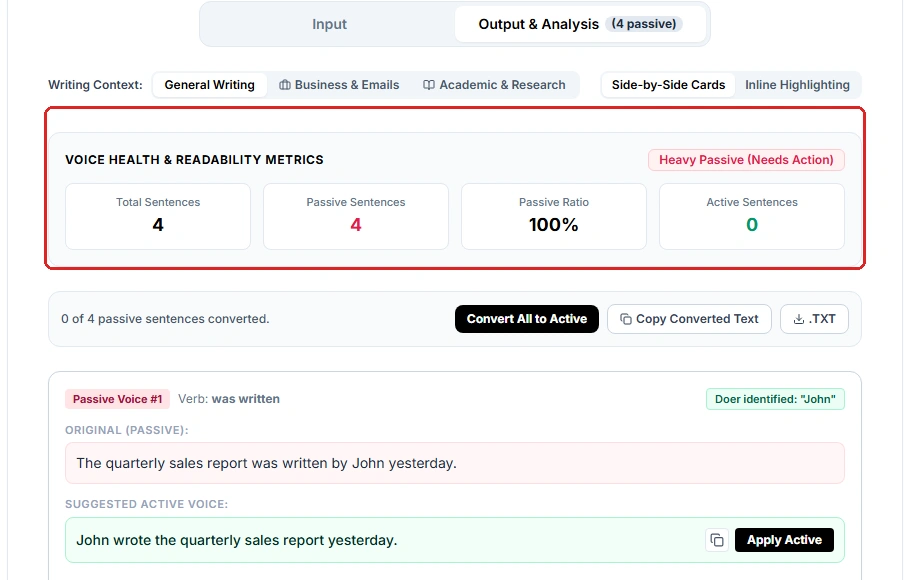
4. 결과 확인 및 복사
새롭게 완성된 능동태 문장을 확인하고 간편하게 복사하세요.
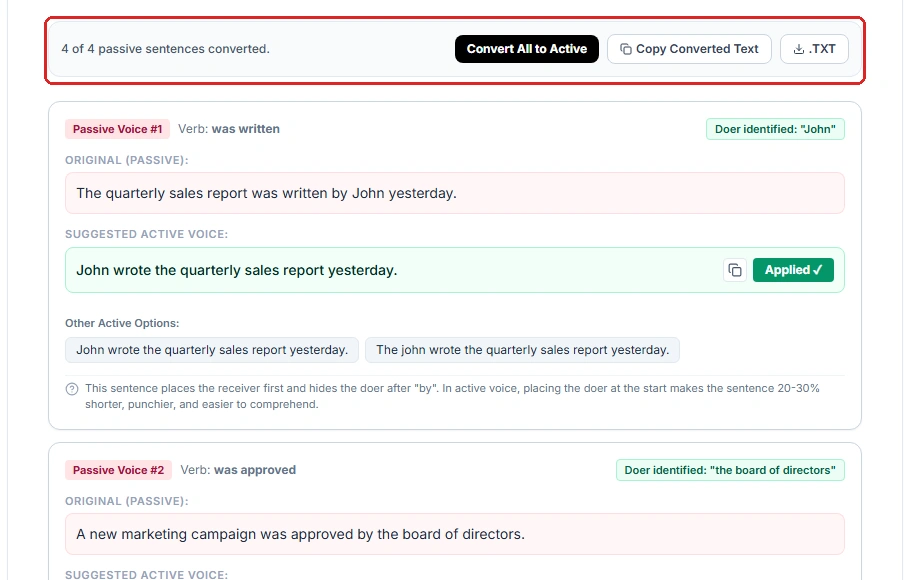
수동태 능동태 변환기 (Passive to Active Voice) Architecture and NLP Processing Pipeline
언어학적 원리에 기반하여 정밀하게 문장을 재배치합니다:
피동 구조 탐지
수동태 표지, 피동 접사, 보조 용언 구문을 정확하게 감지합니다.
행위자 추출
행동을 실제로 수행한 주체 요소를 추출합니다.
구문 순서 재배열
목적어와 주어의 위치를 재배치하고 서술어를 능동형으로 재구성합니다.
주체 생략 문장 복원
행위자가 없는 경우 문맥에 어울리는 자연스러운 주어를 제시합니다.
Linguistic Principles and Foundations of 수동태 능동태 변환기 (Passive to Active Voice)
Understanding the underlying grammatical mechanics and psycholinguistic research behind this utility empowers you to edit with precision:
Syntactic Deconstruction: Subject, Auxiliary Verb, and Agent
In passive voice constructions, the recipient of the action (the patient) is elevated to the subject position, accompanied by a form of the auxiliary verb 'to be' and a past participle, while the actual doer (the agent) is relegated to a prepositional 'by' phrase or omitted entirely. Our converter locates these elements and restores the natural Subject-Verb-Object sequence.
Cognitive Velocity: Why Active Voice Accelerates Comprehension
Psycholinguistic studies demonstrate that the human brain processes Subject-Verb-Object sentences significantly faster than Object-Verb-Subject constructions. Active sentences mirror the natural real-world sequence of cause and effect: an agent performs an action, which impacts a target. Active writing reduces cognitive friction and heightens emotional engagement.
The Legitimate Rhetorical Roles of the Passive Voice
Passive voice is not grammatically incorrect and serves vital functions in specific genres. In scientific methodology sections, the experimenter is less important than the procedure ('The solution was heated to 100°C'). Similarly, in crisis communications or legal drafting, passive voice allows diplomacy when the perpetrator is unknown or intentionally unstated. The goal is intentional usage rather than accidental passive fog.
Eliminating Bureaucratic Obfuscation and Enhancing Accountability
Passive voice is frequently abused in corporate and political communications to evade accountability ('Mistakes were made', 'Deadlines were missed'). Converting these constructions into active voice identifies the accountable parties ('Our team made mistakes', 'The vendor missed deadlines'), fostering institutional transparency and building trust with your audience.
Real-World Case Studies and Sentence Transformations
Examine before-and-after transformations across three distinct writing genres to observe practical editorial refinements in action:
Academic Methodology & Discussion
"The quantitative survey responses were analyzed by our research team using multivariate regression models, and significant correlations were observed between sleep deprivation and cognitive performance."
Diagnostic Critique: Two passive clauses ('were analyzed by our team', 'were observed') that diminish the active authority of the researchers.
Our research team analyzed the quantitative survey responses using multivariate regression models and discovered significant correlations between sleep deprivation and cognitive performance.
Editorial Takeaway: Active voice highlights researcher agency, making scholarly contributions feel bold, authoritative, and direct.
Corporate Incident Post-Mortem
"The erroneous database migration script was executed at midnight by the operations department, and the deployment notification was inadvertently omitted."
Diagnostic Critique: Passive phrasing distances team accountability ('was executed', 'was omitted') and sounds bureaucratic rather than trustworthy.
The operations department executed the erroneous database migration script at midnight and accidentally omitted the deployment notification.
Editorial Takeaway: Direct active voice demonstrates honest organizational accountability, reassuring executive stakeholders and clients.
Landing Page & Product Marketing
"Seamless real-time synchronization across all your desktop and mobile devices is guaranteed by our cloud architecture."
Diagnostic Critique: Passive structure buries the core selling point under sluggish syntax and places the actor at the very end.
Our cloud architecture guarantees seamless real-time synchronization across all your desktop and mobile devices.
Editorial Takeaway: Leading with the active subject and a strong transitive verb energizes marketing copy and boosts conversion clarity.
Common Editorial Mistakes and Traps to Avoid
Even experienced authors can fall into subtle revision traps when restructuring sentences. Keep these precautions in mind:
Forcibly Rewriting Legitimate Scientific Passages
In laboratory reports and empirical methodologies, the scientific apparatus or chemical reaction is the rightful focus ('The sample was centrifuged for 15 minutes'). Forcing active voice ('We centrifuged the sample') can distract from the empirical protocol.
Inventing Speculative or Misleading Agents
When converting agentless passives ('The artifacts were stolen in 1912'), do not invent a fictional actor if historical evidence does not name the perpetrator. Retain passive voice when the actor is genuinely unknown.
Compromising Deliberate Legal Disclaimers
Contracts frequently employ passive voice to assign systemic warranties without placing undue personal liability on individuals. Review legal phrasing carefully before converting passive clauses.
Ignoring Poetic and Dramatic Emphasis
Passive voice intentionally focuses attention on the receiver of the action ('The ancient cathedral was struck by lightning'). Converting this to active voice shifts the emotional focus onto the lightning rather than the historic monument.
Editorial Integration: How 수동태 능동태 변환기 (Passive to Active Voice) Fits Into Your Writing Pipeline
High-impact writing is achieved by combining structural, grammatical, and stylistic editing passes. Here is how professional copyeditors combine 수동태 능동태 변환기 (Passive to Active Voice) with complementary tools in the suite:
Pairing with the Sentence Splitter
Before fine-tuning grammar or tone, run long paragraphs through the Sentence Splitter. Isolating individual sentences on separate lines makes it easy to spot run-on clauses, excessive modifier stacks, and logical gaps across paragraphs.
Pairing with the Run-On Sentence Checker
Syntactic integrity is paramount. Combining 수동태 능동태 변환기 (Passive to Active Voice) with the Run-On Checker ensures that compound structures and spliced clauses are resolved with legitimate punctuation (semicolons, coordinating conjunctions, or periods) before trimming wordiness.
Pairing with the Sentence Shortener
After establishing correct clause boundaries, feed dense segments to the Sentence Shortener. Pruning conversational filler phrases, nominalizations, and pleonasms creates punchy prose that respects the reader's attention.
Pairing with the Passive to Active Converter
Injecting active voice creates energetic, responsible prose. Converting sluggish passive verbs into direct Subject-Verb-Object sequences guarantees that your core message conveys authority and clear ownership.
Final Polish with the Sentence Simplifier
Complete your editorial workflow with the AI Sentence Simplifier. Replace stubborn bureaucratic jargon or academic obscurities with crisp, universally accessible vocabulary that resonates across international audiences.
The Comprehensive Result
Layering these targeted utilities systematically removes cognitive friction. Your writing becomes clear, grammatical, concise, and immediately engaging across both digital displays and printed publications.
Professional Writing Advice: 능동태 활용 가이드
전체 글의 80% 이상을 능동태로 유지
일반적인 글에서는 능동태를 기본으로 사용하는 것이 독자의 몰입을 높입니다.
행위자가 불분명할 때만 수동태 사용
행동의 주체를 알 수 없거나 밝힐 필요가 없을 때에 한해 수동태를 활용하세요.
결과 자체를 강조할 때 활용
행위자보다 사건의 결과가 핵심인 경우 수동태가 효과적일 수 있습니다.
이메일은 항상 능동태 권장
'오류가 발생되었습니다' 대신 '저희가 오류를 수정했습니다'처럼 책임감을 드러내세요.
Complementary Utilities in the Writing Suite
Chain these modular browser tools together to achieve comprehensive structural, grammatical, and stylistic refinement: