
Apa Perbedaan Kalimat Pasif dan Aktif?
Dalam kalimat aktif, subjek melakukan tindakan (misalnya: 'Tim kami menyelesaikan laporan'). Dalam kalimat pasif, subjek menerima tindakan (misalnya: 'Laporan diselesaikan oleh tim kami').
Meskipun kalimat pasif berguna dalam laporan ilmiah tertentu, penggunaannya yang berlebihan dapat membuat tulisan terasa kaku, tidak tegas, dan berbelit-belit. Kalimat aktif membuat tulisan lebih hidup.
Mengapa Menggunakan Kalimat Aktif? — Key Capabilities
Kalimat aktif memberikan 4 keunggulan nyata dalam komunikasi tulisan:
01Lebih Menarik & Bertenaga
Menempatkan pelaku tindakan di awal kalimat menciptakan kesan dinamis dan meyakinkan bagi pembaca.
02Kejelasan Tanggung Jawab
Menghilangkan keraguan dengan menegaskan siapa yang membuat keputusan atau melakukan pekerjaan.
03Hemat Kata & Lebih Efisien
Konstruksi aktif secara alami menghilangkan kata bantu dan frasa imbuhan pasif yang panjang.
04Deteksi Pelaku Tindakan Otomatis
Mesin kami mengenali pelaku aksi dan menyusun ulang struktur kalimat secara otomatis.
How to Use Kalimat Pasif ke Aktif (Passive to Active Voice) Step-by-Step
Ubah suara kalimat dalam 4 langkah sederhana:
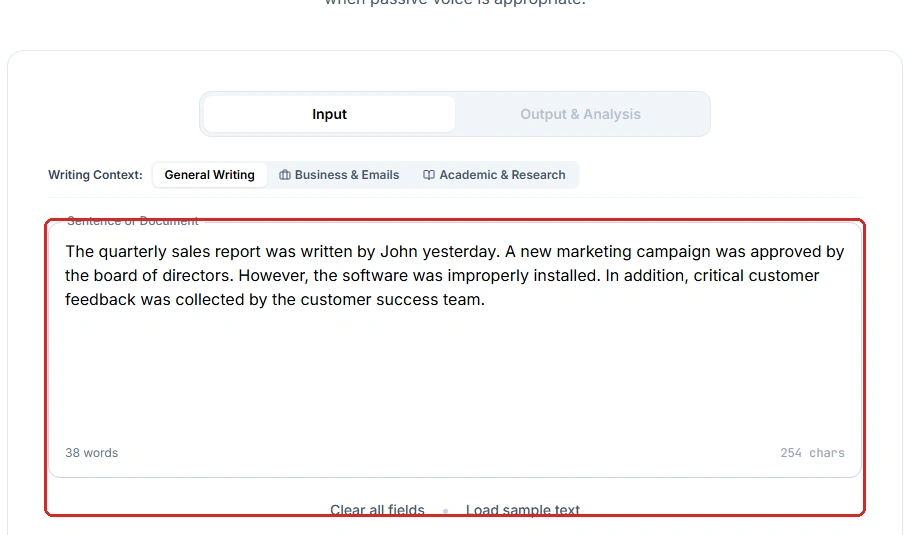
1. Masukkan Tulisan Anda
Ketik atau tempel kalimat pasif Anda ke dalam kolom di atas.
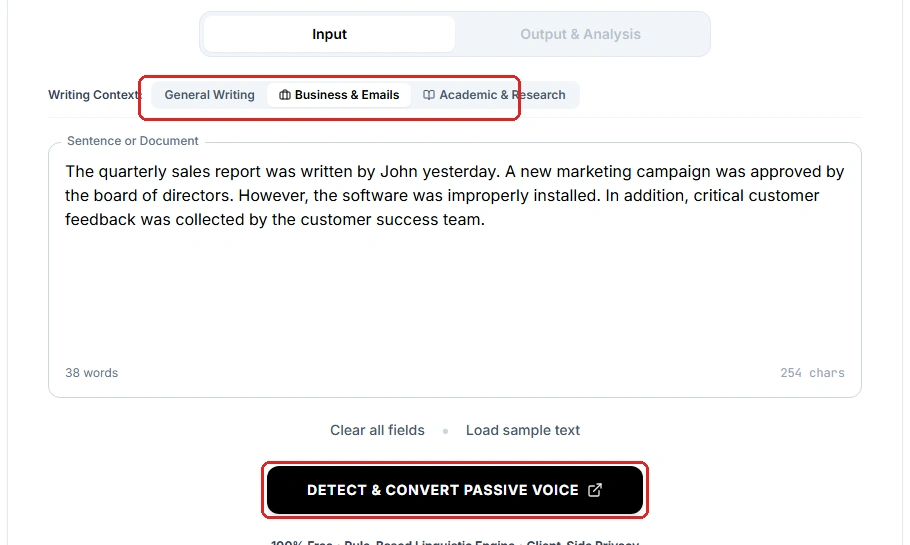
2. Pilih Gaya Tulisan
Tentukan gaya Umum, Akademik, atau Bisnis sesuai target pembaca Anda.
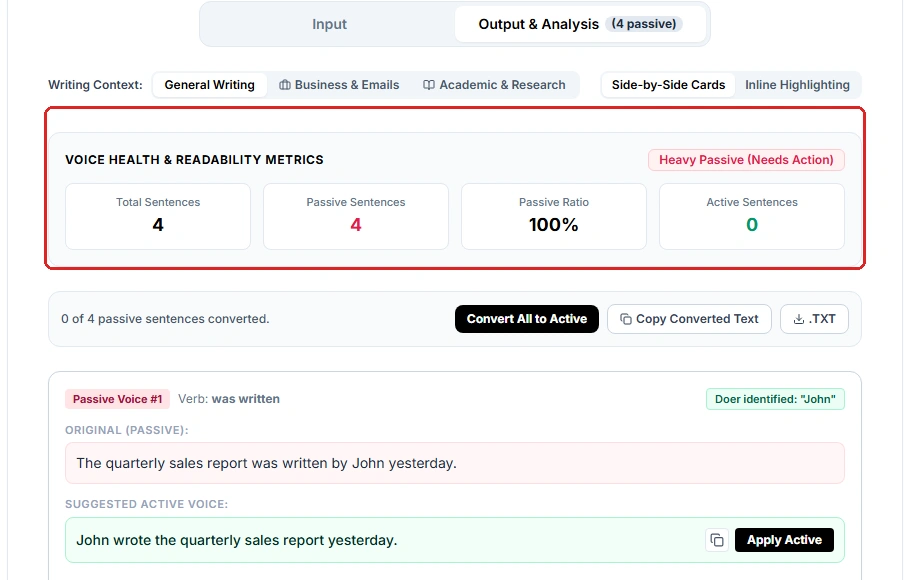
3. Klik Ubah ke Kalimat Aktif
Sistem akan mendeteksi indikator pasif dan membalik struktur kalimat menjadi aktif.
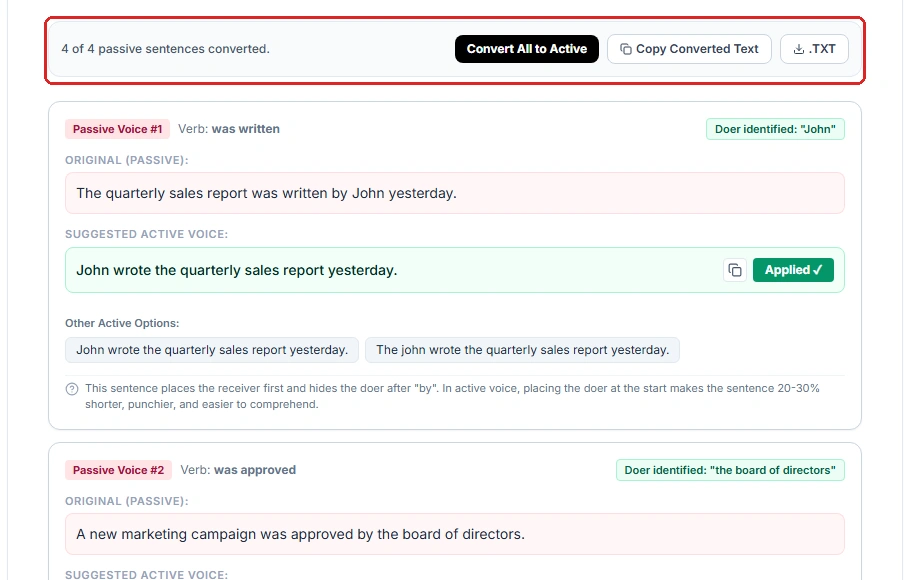
4. Periksa dan Salin
Lihat hasil transformasi aktif berdampingan dengan teks asli, lalu salin dengan satu klik.
Kalimat Pasif ke Aktif (Passive to Active Voice) Architecture and NLP Processing Pipeline
Sistem transformasi kami menerapkan analisis sintaksis bertahap:
Deteksi Morfologi Pasif
Mengenali imbuhan pasif (seperti di-, ter-, ke-...-an) dan kata kerja bantu pasif.
Identifikasi Frasa Pelaku
Menemukan frasa 'oleh [pelaku]' untuk menentukan siapa yang sebenarnya melakukan tindakan.
Penyusunan Ulang Sintaksis
Menukar posisi objek menjadi subjek dan mengubah kata kerja menjadi bentuk aktif yang dinamis.
Rekonstruksi Pasif Tanpa Pelaku
Bila pelaku tidak disebutkan, sistem menyarankan subjek umum yang sesuai dengan konteks.
Linguistic Principles and Foundations of Kalimat Pasif ke Aktif (Passive to Active Voice)
Understanding the underlying grammatical mechanics and psycholinguistic research behind this utility empowers you to edit with precision:
Syntactic Deconstruction: Subject, Auxiliary Verb, and Agent
In passive voice constructions, the recipient of the action (the patient) is elevated to the subject position, accompanied by a form of the auxiliary verb 'to be' and a past participle, while the actual doer (the agent) is relegated to a prepositional 'by' phrase or omitted entirely. Our converter locates these elements and restores the natural Subject-Verb-Object sequence.
Cognitive Velocity: Why Active Voice Accelerates Comprehension
Psycholinguistic studies demonstrate that the human brain processes Subject-Verb-Object sentences significantly faster than Object-Verb-Subject constructions. Active sentences mirror the natural real-world sequence of cause and effect: an agent performs an action, which impacts a target. Active writing reduces cognitive friction and heightens emotional engagement.
The Legitimate Rhetorical Roles of the Passive Voice
Passive voice is not grammatically incorrect and serves vital functions in specific genres. In scientific methodology sections, the experimenter is less important than the procedure ('The solution was heated to 100°C'). Similarly, in crisis communications or legal drafting, passive voice allows diplomacy when the perpetrator is unknown or intentionally unstated. The goal is intentional usage rather than accidental passive fog.
Eliminating Bureaucratic Obfuscation and Enhancing Accountability
Passive voice is frequently abused in corporate and political communications to evade accountability ('Mistakes were made', 'Deadlines were missed'). Converting these constructions into active voice identifies the accountable parties ('Our team made mistakes', 'The vendor missed deadlines'), fostering institutional transparency and building trust with your audience.
Real-World Case Studies and Sentence Transformations
Examine before-and-after transformations across three distinct writing genres to observe practical editorial refinements in action:
Academic Methodology & Discussion
"The quantitative survey responses were analyzed by our research team using multivariate regression models, and significant correlations were observed between sleep deprivation and cognitive performance."
Diagnostic Critique: Two passive clauses ('were analyzed by our team', 'were observed') that diminish the active authority of the researchers.
Our research team analyzed the quantitative survey responses using multivariate regression models and discovered significant correlations between sleep deprivation and cognitive performance.
Editorial Takeaway: Active voice highlights researcher agency, making scholarly contributions feel bold, authoritative, and direct.
Corporate Incident Post-Mortem
"The erroneous database migration script was executed at midnight by the operations department, and the deployment notification was inadvertently omitted."
Diagnostic Critique: Passive phrasing distances team accountability ('was executed', 'was omitted') and sounds bureaucratic rather than trustworthy.
The operations department executed the erroneous database migration script at midnight and accidentally omitted the deployment notification.
Editorial Takeaway: Direct active voice demonstrates honest organizational accountability, reassuring executive stakeholders and clients.
Landing Page & Product Marketing
"Seamless real-time synchronization across all your desktop and mobile devices is guaranteed by our cloud architecture."
Diagnostic Critique: Passive structure buries the core selling point under sluggish syntax and places the actor at the very end.
Our cloud architecture guarantees seamless real-time synchronization across all your desktop and mobile devices.
Editorial Takeaway: Leading with the active subject and a strong transitive verb energizes marketing copy and boosts conversion clarity.
Common Editorial Mistakes and Traps to Avoid
Even experienced authors can fall into subtle revision traps when restructuring sentences. Keep these precautions in mind:
Forcibly Rewriting Legitimate Scientific Passages
In laboratory reports and empirical methodologies, the scientific apparatus or chemical reaction is the rightful focus ('The sample was centrifuged for 15 minutes'). Forcing active voice ('We centrifuged the sample') can distract from the empirical protocol.
Inventing Speculative or Misleading Agents
When converting agentless passives ('The artifacts were stolen in 1912'), do not invent a fictional actor if historical evidence does not name the perpetrator. Retain passive voice when the actor is genuinely unknown.
Compromising Deliberate Legal Disclaimers
Contracts frequently employ passive voice to assign systemic warranties without placing undue personal liability on individuals. Review legal phrasing carefully before converting passive clauses.
Ignoring Poetic and Dramatic Emphasis
Passive voice intentionally focuses attention on the receiver of the action ('The ancient cathedral was struck by lightning'). Converting this to active voice shifts the emotional focus onto the lightning rather than the historic monument.
Editorial Integration: How Kalimat Pasif ke Aktif (Passive to Active Voice) Fits Into Your Writing Pipeline
High-impact writing is achieved by combining structural, grammatical, and stylistic editing passes. Here is how professional copyeditors combine Kalimat Pasif ke Aktif (Passive to Active Voice) with complementary tools in the suite:
Pairing with the Sentence Splitter
Before fine-tuning grammar or tone, run long paragraphs through the Sentence Splitter. Isolating individual sentences on separate lines makes it easy to spot run-on clauses, excessive modifier stacks, and logical gaps across paragraphs.
Pairing with the Run-On Sentence Checker
Syntactic integrity is paramount. Combining Kalimat Pasif ke Aktif (Passive to Active Voice) with the Run-On Checker ensures that compound structures and spliced clauses are resolved with legitimate punctuation (semicolons, coordinating conjunctions, or periods) before trimming wordiness.
Pairing with the Sentence Shortener
After establishing correct clause boundaries, feed dense segments to the Sentence Shortener. Pruning conversational filler phrases, nominalizations, and pleonasms creates punchy prose that respects the reader's attention.
Pairing with the Passive to Active Converter
Injecting active voice creates energetic, responsible prose. Converting sluggish passive verbs into direct Subject-Verb-Object sequences guarantees that your core message conveys authority and clear ownership.
Final Polish with the Sentence Simplifier
Complete your editorial workflow with the AI Sentence Simplifier. Replace stubborn bureaucratic jargon or academic obscurities with crisp, universally accessible vocabulary that resonates across international audiences.
The Comprehensive Result
Layering these targeted utilities systematically removes cognitive friction. Your writing becomes clear, grammatical, concise, and immediately engaging across both digital displays and printed publications.
Professional Writing Advice: Kapan Menggunakan Kalimat Aktif vs Pasif?
Gunakan Kalimat Aktif sebagai Standar
Usahakan lebih dari 80% kalimat Anda berbentuk aktif agar tulisan tetap dinamis dan tegas.
Gunakan Pasif Bila Pelaku Tidak Diketahui
Contoh: 'Dokumen itu hilang kemarin malam' (pelakunya tidak diketahui atau tidak penting).
Gunakan Pasif untuk Menekankan Objek
Contoh: 'Undang-undang tersebut disahkan kemarin' (undang-undang adalah fokus perhatian utama).
Hindari Pasif dalam Email Bisnis
Tulis 'Saya telah mengirim berkasnya' alih-alih 'Berkasnya telah dikirim oleh saya' demi kesan profesional.
Complementary Utilities in the Writing Suite
Chain these modular browser tools together to achieve comprehensive structural, grammatical, and stylistic refinement: