
受動態と能動態の違い
能動態では動作主が主語として行動します(例:「チームがプロジェクトを完了した」)。受動態では行動を受ける側が主語になります(例:「プロジェクトがチームによって完了された」)。
学術的な実験手順などでは受動態も使われますが、一般的な文章では能動態の方がダイレクトで力強く、誰が責任を持つのかが明確になります。
能動態にするメリット — Key Capabilities
受動態を能動態に変えることで、文章の説得力が一段と上がります:
01力強く伝わる
動作主を前に出すことで、文章にスピード感と迫力が生まれます。
02責任の明確化
誰がその判断や行動を行ったのかがはっきりと伝わります。
03無駄な文字の削減
「〜によって〜される」といった回りくどい表現を省けます。
04動作主の自動推定
文中に動作主が隠れている場合も自動で文脈を補正します。
How to Use 受動態・能動態変換 (Passive to Active) Step-by-Step
4つのステップで能動態に変換:
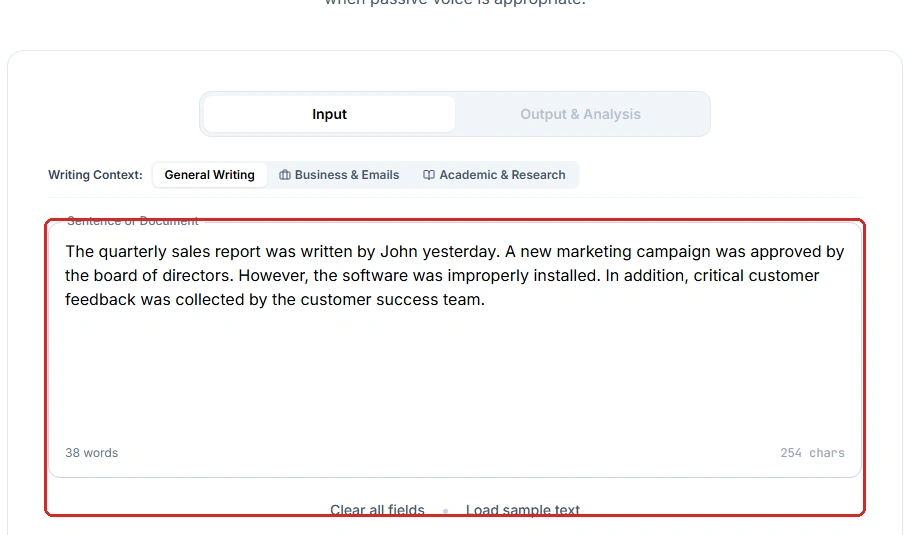
1. 原稿を入力
変換したい文章を入力欄に入れます。
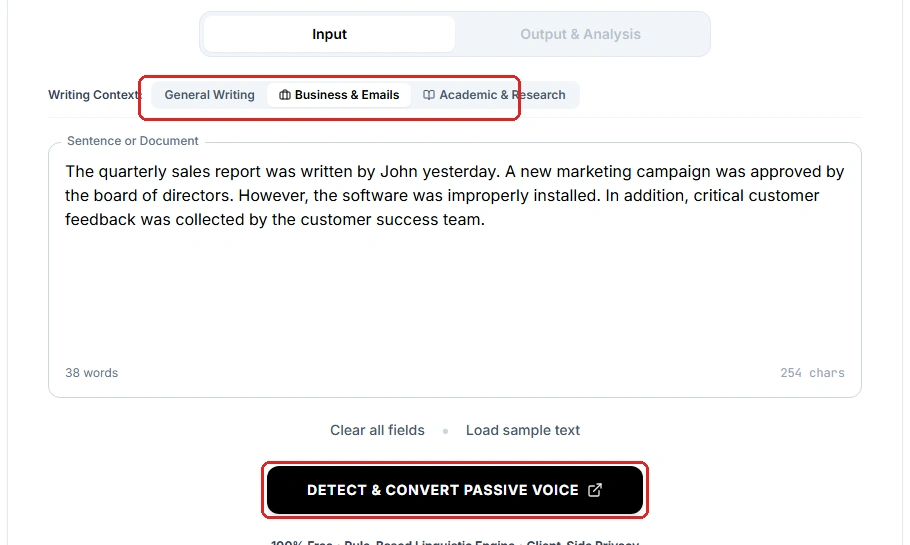
2. 文体を選択
一般、学術、ビジネスからスタイルを指定。
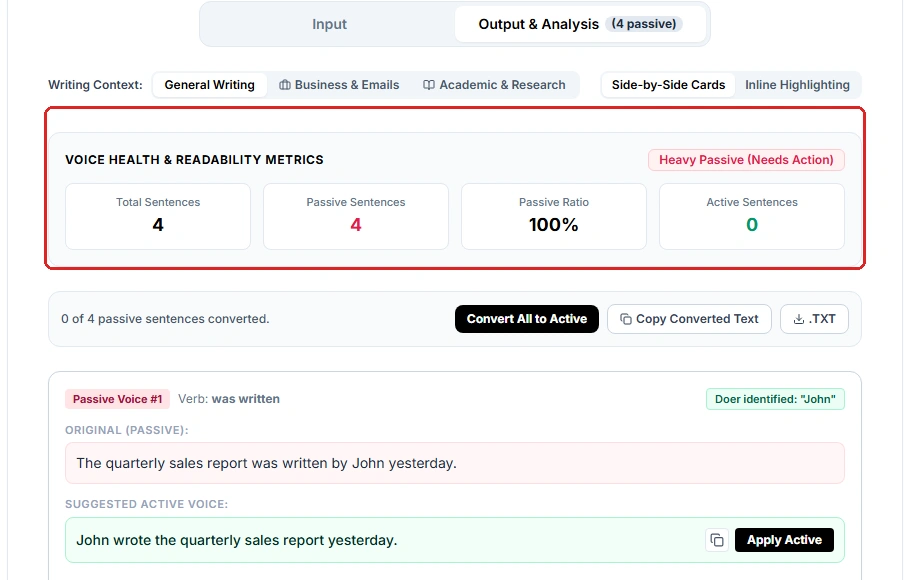
3. 変換を実行
受動態の構造を能動的な構文へと反転。
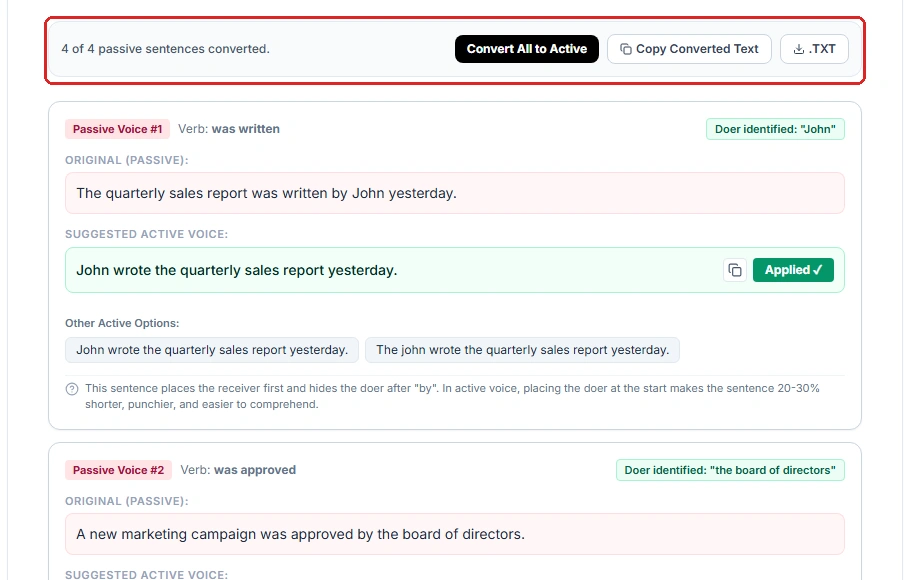
4. 結果を活用
改善された積極的な文章をコピーして使用。
受動態・能動態変換 (Passive to Active) Architecture and NLP Processing Pipeline
高度な構文解析により文の主客を入れ替えます:
受動態パターンの特定
受け身を表す助動詞や構文をすばやく検出。
動作主(エージェント)の抽出
「〜によって」などで示された実際の行動者を特定。
構文の主客反転
動作主を主語に据え直し、動詞を能動形に活用。
動作主不在の補正
主語が省略されている場合、文脈に沿った自然な主語を補足。
Linguistic Principles and Foundations of 受動態・能動態変換 (Passive to Active)
Understanding the underlying grammatical mechanics and psycholinguistic research behind this utility empowers you to edit with precision:
Syntactic Deconstruction: Subject, Auxiliary Verb, and Agent
In passive voice constructions, the recipient of the action (the patient) is elevated to the subject position, accompanied by a form of the auxiliary verb 'to be' and a past participle, while the actual doer (the agent) is relegated to a prepositional 'by' phrase or omitted entirely. Our converter locates these elements and restores the natural Subject-Verb-Object sequence.
Cognitive Velocity: Why Active Voice Accelerates Comprehension
Psycholinguistic studies demonstrate that the human brain processes Subject-Verb-Object sentences significantly faster than Object-Verb-Subject constructions. Active sentences mirror the natural real-world sequence of cause and effect: an agent performs an action, which impacts a target. Active writing reduces cognitive friction and heightens emotional engagement.
The Legitimate Rhetorical Roles of the Passive Voice
Passive voice is not grammatically incorrect and serves vital functions in specific genres. In scientific methodology sections, the experimenter is less important than the procedure ('The solution was heated to 100°C'). Similarly, in crisis communications or legal drafting, passive voice allows diplomacy when the perpetrator is unknown or intentionally unstated. The goal is intentional usage rather than accidental passive fog.
Eliminating Bureaucratic Obfuscation and Enhancing Accountability
Passive voice is frequently abused in corporate and political communications to evade accountability ('Mistakes were made', 'Deadlines were missed'). Converting these constructions into active voice identifies the accountable parties ('Our team made mistakes', 'The vendor missed deadlines'), fostering institutional transparency and building trust with your audience.
Real-World Case Studies and Sentence Transformations
Examine before-and-after transformations across three distinct writing genres to observe practical editorial refinements in action:
Academic Methodology & Discussion
"The quantitative survey responses were analyzed by our research team using multivariate regression models, and significant correlations were observed between sleep deprivation and cognitive performance."
Diagnostic Critique: Two passive clauses ('were analyzed by our team', 'were observed') that diminish the active authority of the researchers.
Our research team analyzed the quantitative survey responses using multivariate regression models and discovered significant correlations between sleep deprivation and cognitive performance.
Editorial Takeaway: Active voice highlights researcher agency, making scholarly contributions feel bold, authoritative, and direct.
Corporate Incident Post-Mortem
"The erroneous database migration script was executed at midnight by the operations department, and the deployment notification was inadvertently omitted."
Diagnostic Critique: Passive phrasing distances team accountability ('was executed', 'was omitted') and sounds bureaucratic rather than trustworthy.
The operations department executed the erroneous database migration script at midnight and accidentally omitted the deployment notification.
Editorial Takeaway: Direct active voice demonstrates honest organizational accountability, reassuring executive stakeholders and clients.
Landing Page & Product Marketing
"Seamless real-time synchronization across all your desktop and mobile devices is guaranteed by our cloud architecture."
Diagnostic Critique: Passive structure buries the core selling point under sluggish syntax and places the actor at the very end.
Our cloud architecture guarantees seamless real-time synchronization across all your desktop and mobile devices.
Editorial Takeaway: Leading with the active subject and a strong transitive verb energizes marketing copy and boosts conversion clarity.
Common Editorial Mistakes and Traps to Avoid
Even experienced authors can fall into subtle revision traps when restructuring sentences. Keep these precautions in mind:
Forcibly Rewriting Legitimate Scientific Passages
In laboratory reports and empirical methodologies, the scientific apparatus or chemical reaction is the rightful focus ('The sample was centrifuged for 15 minutes'). Forcing active voice ('We centrifuged the sample') can distract from the empirical protocol.
Inventing Speculative or Misleading Agents
When converting agentless passives ('The artifacts were stolen in 1912'), do not invent a fictional actor if historical evidence does not name the perpetrator. Retain passive voice when the actor is genuinely unknown.
Compromising Deliberate Legal Disclaimers
Contracts frequently employ passive voice to assign systemic warranties without placing undue personal liability on individuals. Review legal phrasing carefully before converting passive clauses.
Ignoring Poetic and Dramatic Emphasis
Passive voice intentionally focuses attention on the receiver of the action ('The ancient cathedral was struck by lightning'). Converting this to active voice shifts the emotional focus onto the lightning rather than the historic monument.
Editorial Integration: How 受動態・能動態変換 (Passive to Active) Fits Into Your Writing Pipeline
High-impact writing is achieved by combining structural, grammatical, and stylistic editing passes. Here is how professional copyeditors combine 受動態・能動態変換 (Passive to Active) with complementary tools in the suite:
Pairing with the Sentence Splitter
Before fine-tuning grammar or tone, run long paragraphs through the Sentence Splitter. Isolating individual sentences on separate lines makes it easy to spot run-on clauses, excessive modifier stacks, and logical gaps across paragraphs.
Pairing with the Run-On Sentence Checker
Syntactic integrity is paramount. Combining 受動態・能動態変換 (Passive to Active) with the Run-On Checker ensures that compound structures and spliced clauses are resolved with legitimate punctuation (semicolons, coordinating conjunctions, or periods) before trimming wordiness.
Pairing with the Sentence Shortener
After establishing correct clause boundaries, feed dense segments to the Sentence Shortener. Pruning conversational filler phrases, nominalizations, and pleonasms creates punchy prose that respects the reader's attention.
Pairing with the Passive to Active Converter
Injecting active voice creates energetic, responsible prose. Converting sluggish passive verbs into direct Subject-Verb-Object sequences guarantees that your core message conveys authority and clear ownership.
Final Polish with the Sentence Simplifier
Complete your editorial workflow with the AI Sentence Simplifier. Replace stubborn bureaucratic jargon or academic obscurities with crisp, universally accessible vocabulary that resonates across international audiences.
The Comprehensive Result
Layering these targeted utilities systematically removes cognitive friction. Your writing becomes clear, grammatical, concise, and immediately engaging across both digital displays and printed publications.
Professional Writing Advice: 使い分けのヒント
基本は8割以上を能動態に
積極的でわかりやすい文章を作るための鉄則です。
動作主が不明なときは受動態
例:「その寺院は1200年に建立された」(建てた人物が不明)。
結果を強調したいときは受動態
例:「新法案が可決された」(法案そのものが主役の場合)。
ビジネスメールは能動態で
「ミスが発生しました」ではなく「私が確認を誤りました」と率直に。
Complementary Utilities in the Writing Suite
Chain these modular browser tools together to achieve comprehensive structural, grammatical, and stylistic refinement: