
What is a Sentence Shortener?
A sentence shortener is a writing concision tool that scans your text for unnecessary fluff, verbose phrasings, and passive wordiness, replacing them with sharp, economical alternatives.
Rather than cutting out essential thoughts, it trims linguistic padding—such as 'due to the fact that' into 'because'—to strengthen your voice while preserving every crucial nuance.
Why Use Our Sentence Shortener? — Key Capabilities
Clear and concise writing delivers significant communication benefits:
01Maximum Concision
Reduce word counts by up to 40% while preserving every factual detail and core argument.
02Eliminate Wordy Fillers
Instantly remove empty crutch words like 'actually', 'basically', and 'needless to say'.
03Visual Strikethrough Diffs
Easily see exactly which words were removed, modified, or preserved in your text.
04Full Privacy Guaranteed
Runs 100% locally in your browser. Your confidential writing never touches an external server.
How to Use Sentence Shortener Step-by-Step
Tighten your sentences in 4 straightforward steps:
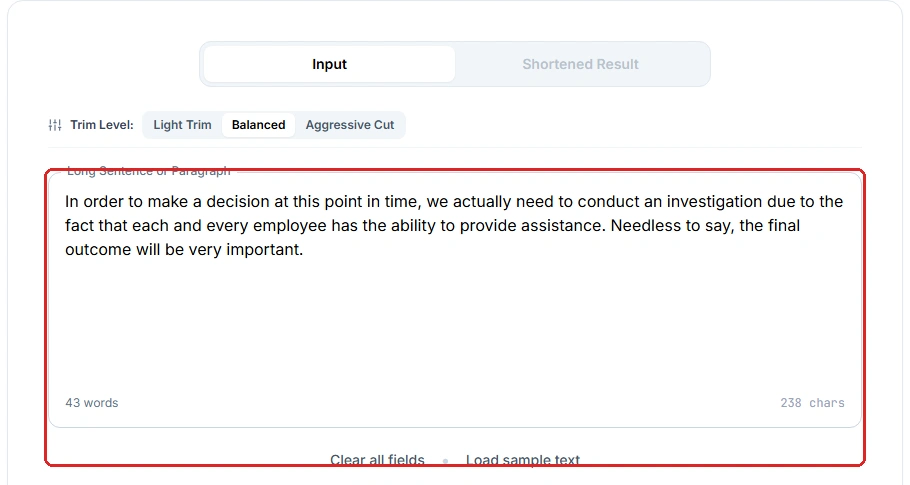
1. Paste Your Text
Add your text into the editor. Great for essays, emails, resumes, and executive briefs.
2. Choose Shortening Level
Select Light (subtle fixes), Moderate (recommended), or Aggressive (maximum concision).
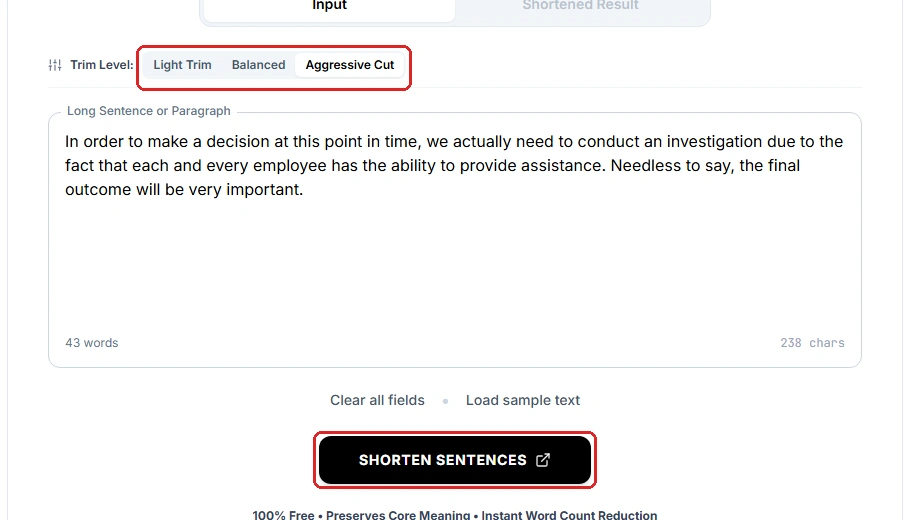
3. Click Shorten Sentences
Our engine analyzes grammatical structures and suggests crisp replacements instantly.
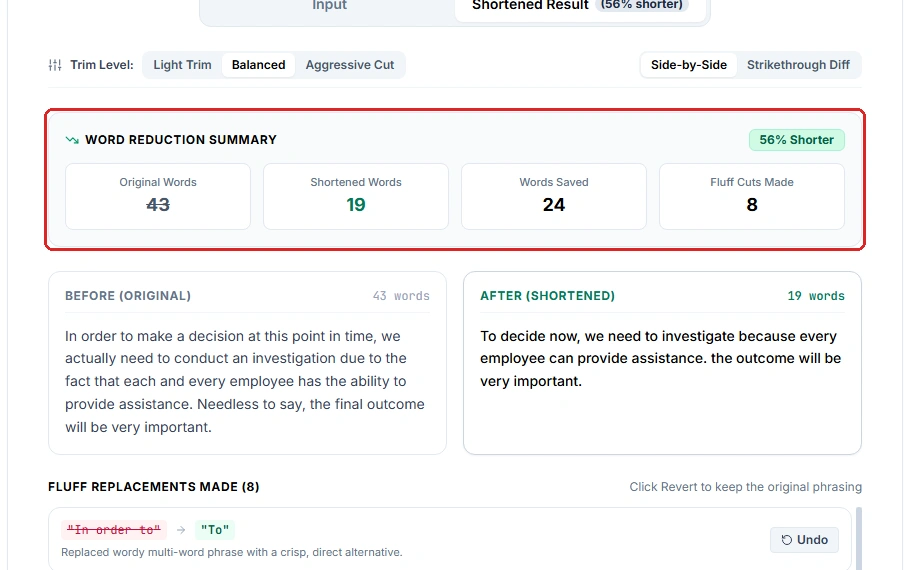
4. Review and Copy
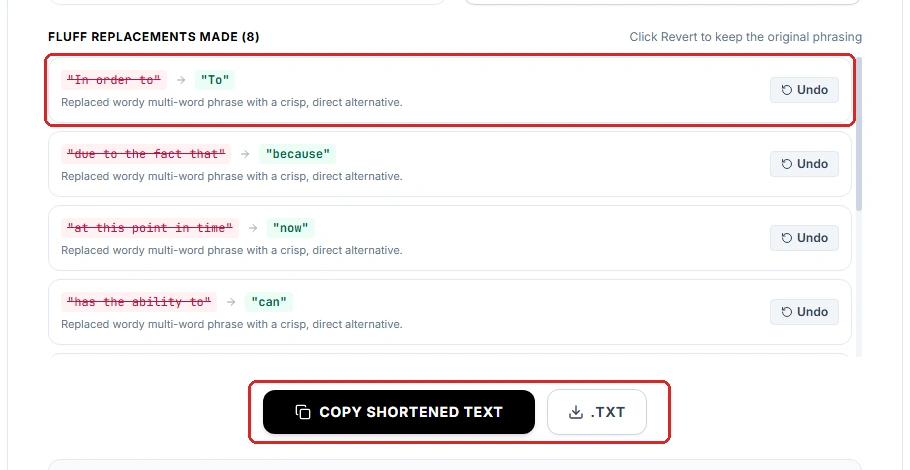
Inspect the word reduction percentage, fine-tune individual edits, and copy the clean text.
Sentence Shortener Architecture and NLP Processing Pipeline
Our concision algorithm employs targeted linguistic rules:
Redundancy Detection
Identifies doublets and redundant phrases like 'completely unanimous' or 'past history'.
Filler Word Pruning
Strips meaningless hedges and conversational padding that dilute authoritative prose.
Nominalization Unpacking
Converts weak noun constructs like 'conduct an investigation' into vigorous verbs like 'investigate'.
Syntax Tightening
Restructures wordy clauses into clean, direct subject-verb constructions.
Linguistic Principles and Foundations of Sentence Shortener
Understanding the underlying grammatical mechanics and psycholinguistic research behind this utility empowers you to edit with precision:
The Mechanics of Concision: Pruning Nominalizations
Nominalization—the habit of turning vibrant verbs into clumsy nouns (such as changing 'decide' to 'make a decision' or 'investigate' to 'conduct an investigation of')—is the primary cause of bloated prose. The Sentence Shortener systematically detects nominalized verb constructions and restores direct verbal action, slashing syllable counts and invigorating sentence cadence.
Eliminating Pleonasms, Tautologies, and Word Doublets
Tautologies are rhetorical redundancies where two words convey the identical meaning: 'advance planning', 'past history', 'completely finish', or 'free gift'. Doublets such as 'first and foremost' or 'each and every' clutter sentences without adding communicative value. Cutting tautological deadwood tightens your arguments and respects your reader's valuable time.
Throat-Clearing Openers and Expletive Constructions
Many writers begin sentences with hesitation phrases: 'It is important to note that...', 'There are many factors which...', or 'For all intents and purposes...'. Known grammatically as expletive constructions, these fillers postpone the arrival of the true grammatical subject. Pruning them allows your ideas to command immediate attention from the opening word.
Semantic Density: Maximizing Meaning While Minimizing Word Count
True concision is not merely about deleting words; it is about maximizing semantic density—the ratio of substantive information to total syllables. High semantic density distinguishes authoritative, memorable writing from sloppy drafts. By eliminating syntactic dead weight, your core evidence, statistics, and arguments shine through with razor-sharp clarity.
Real-World Case Studies and Sentence Transformations
Examine before-and-after transformations across three distinct writing genres to observe practical editorial refinements in action:
Academic Abstract & Research Grant
"In spite of the fact that previous empirical investigations have arrived at the conclusion that temperature fluctuations have a detrimental effect on enzyme stability, there is an absolute necessity for additional research in order to verify this phenomenon."
Diagnostic Critique: At 38 words, this sentence is drowning in conversational padding ('in spite of the fact that', 'arrived at the conclusion that', 'there is an absolute necessity for').
Although previous studies concluded that temperature fluctuations reduce enzyme stability, further research must verify this phenomenon.
Editorial Takeaway: Trimming the word count from 38 words to 18 words (a 52% reduction) clarifies the research rationale while preserving full scholarly precision.
Business Email & Client Communication
"We are writing this email at the present moment in order to give you advance warning that we will be holding a meeting for the purpose of discussing the new contract terms on Monday next week."
Diagnostic Critique: Overloaded with verbose idioms ('at the present moment', 'give you advance warning', 'for the purpose of discussing').
We are writing to notify you that we will meet next Monday to discuss the new contract terms.
Editorial Takeaway: Replacing conversational throat-clearing with direct verbs reduces 34 words to 16 words, respecting busy professional colleagues.
User Interface & Marketing Copy
"Our platform provides users with the ultimate ability to completely customize and personalize each and every single setting according to their own personal preferences."
Diagnostic Critique: Contains multiple tautological doublets: 'completely customize and personalize', 'each and every single', 'their own personal preferences'.
Our platform lets you customize all settings to your preferences.
Editorial Takeaway: Cutting redundant modifiers sharpens product value propositions and accelerates reader action.
Common Editorial Mistakes and Traps to Avoid
Even experienced authors can fall into subtle revision traps when restructuring sentences. Keep these precautions in mind:
Accidentally Stripping Critical Modal Qualifiers
Words like 'may', 'might', 'must', and 'conditionally' define scientific and legal certainty. Never remove modal verbs simply to meet a word count goal if it converts a cautious hypothesis into an unverified fact.
Eliminating Human Voice and Conversational Warmth
Excessive shortening can strip prose of empathy, humor, and distinctive personality. Ensure professional emails maintain appropriate politeness markers and personal rapport.
Creating Telegraphic, Monotonous Prose
Varying sentence length creates rhythm. If every sentence is condensed to exactly 8 words, the writing sounds robotic and exhausting. Balance punchy short sentences with occasional longer structures.
Failing to Verify Numbers, Proper Nouns, and Dates
Always verify that numerical metrics, project names, and deadlines were not altered or omitted during aggressive syntactic trimming.
Editorial Integration: How Sentence Shortener Fits Into Your Writing Pipeline
High-impact writing is achieved by combining structural, grammatical, and stylistic editing passes. Here is how professional copyeditors combine Sentence Shortener with complementary tools in the suite:
Pairing with the Sentence Splitter
Before fine-tuning grammar or tone, run long paragraphs through the Sentence Splitter. Isolating individual sentences on separate lines makes it easy to spot run-on clauses, excessive modifier stacks, and logical gaps across paragraphs.
Pairing with the Run-On Sentence Checker
Syntactic integrity is paramount. Combining Sentence Shortener with the Run-On Checker ensures that compound structures and spliced clauses are resolved with legitimate punctuation (semicolons, coordinating conjunctions, or periods) before trimming wordiness.
Pairing with the Sentence Shortener
After establishing correct clause boundaries, feed dense segments to the Sentence Shortener. Pruning conversational filler phrases, nominalizations, and pleonasms creates punchy prose that respects the reader's attention.
Pairing with the Passive to Active Converter
Injecting active voice creates energetic, responsible prose. Converting sluggish passive verbs into direct Subject-Verb-Object sequences guarantees that your core message conveys authority and clear ownership.
Final Polish with the Sentence Simplifier
Complete your editorial workflow with the AI Sentence Simplifier. Replace stubborn bureaucratic jargon or academic obscurities with crisp, universally accessible vocabulary that resonates across international audiences.
The Comprehensive Result
Layering these targeted utilities systematically removes cognitive friction. Your writing becomes clear, grammatical, concise, and immediately engaging across both digital displays and printed publications.
Professional Writing Advice: Tips for Concise Writing
Eliminate Throat-Clearing
Remove phrases like 'It is important to remember that' and jump straight to the point.
Prefer Active Verbs
Strong verbs eliminate the need for extra auxiliary words and adverbs.
Cut Redundant Modifiers
Avoid modifiers like 'very', 'extremely', and 'quite'—choose stronger single words instead.
Count Your Words
Aim for an average sentence length of 15-20 words for maximum impact.
Complementary Utilities in the Writing Suite
Chain these modular browser tools together to achieve comprehensive structural, grammatical, and stylistic refinement: