
O que é um Divisor de Frases?
Um divisor de frases é uma ferramenta de processamento de linguagem natural desenvolvida para repartir textos contínuos em orações individuais e estruturadas.
Diferente de scripts simples que quebram o texto em qualquer ponto final, nosso algoritmo identifica títulos (Dr., Sr., etc.), decimais e citações para garantir exatidão.
Por Que Usar Nosso Divisor de Frases? — Key Capabilities
Escritores, tradutores e pesquisadores escolhem nossa ferramenta por 4 vantagens principais:
01Melhora a Legibilidade
Dividir parágrafos compridos em frases curtas torna a leitura muito mais agradável em qualquer dispositivo.
02Preserva o Sentido Original
A quebra é realizada sem alterar vocabulário ou deturpar o contexto da sua mensagem.
03Economiza Tempo Valioso
Processe milhares de palavras em instantes sem quebras de linha manuais exaustivas.
04Precisão com NLP
Resguarda links, termos abreviados e marcas de pontuação características de vários idiomas.
How to Use Divisor de Frases Step-by-Step
Segmente seus parágrafos em 4 etapas simples:
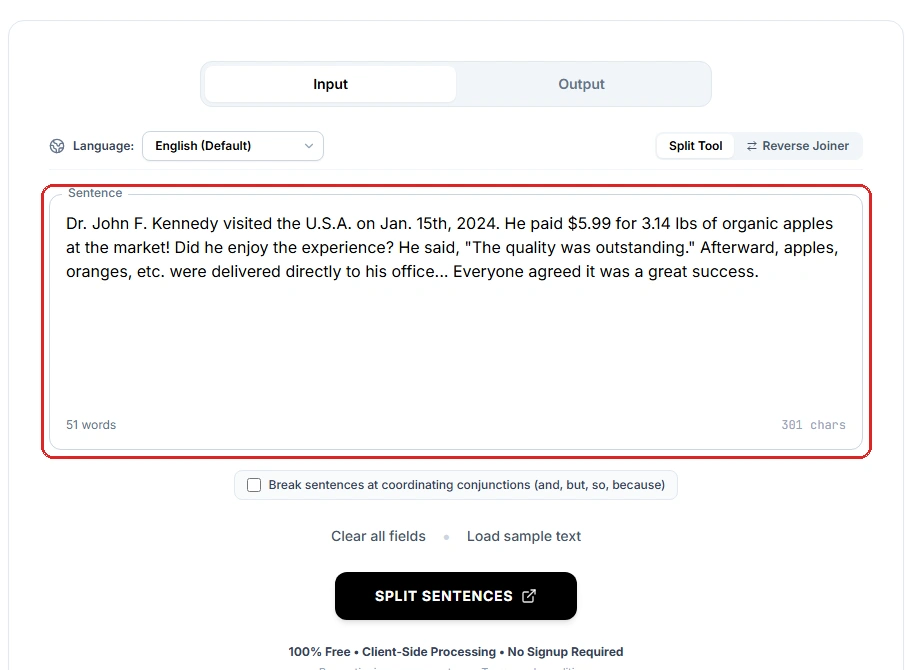
1. Cole Seu Texto
Insira seus parágrafos no editor. Suporta até 100.000 caracteres por vez.
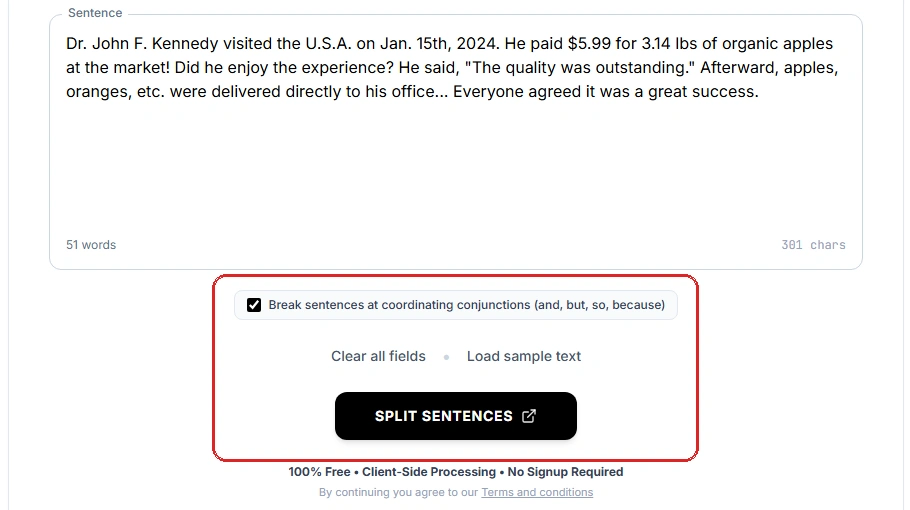
2. Configure as Opções
Escolha o idioma e ative se desejar a divisão por conjunções coordenativas.
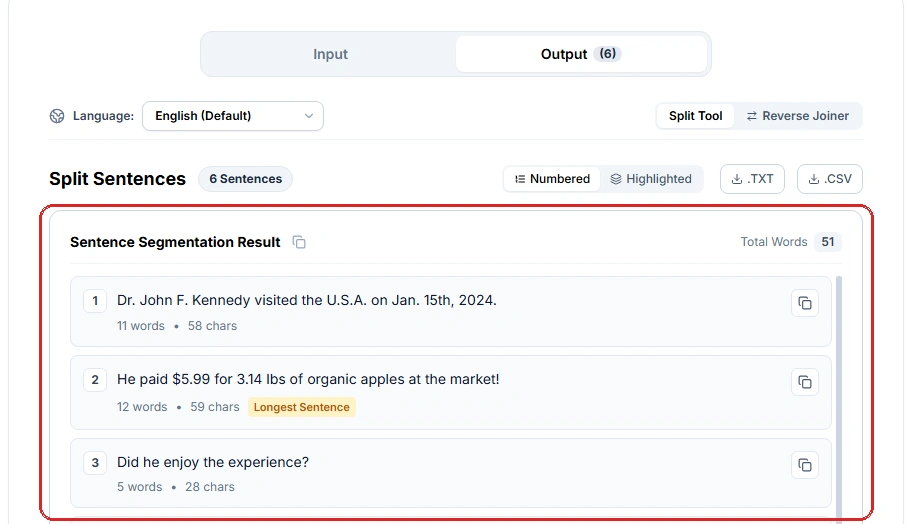
3. Clique em Dividir Frases
Veja cada frase organizada em linhas numeradas independentes.
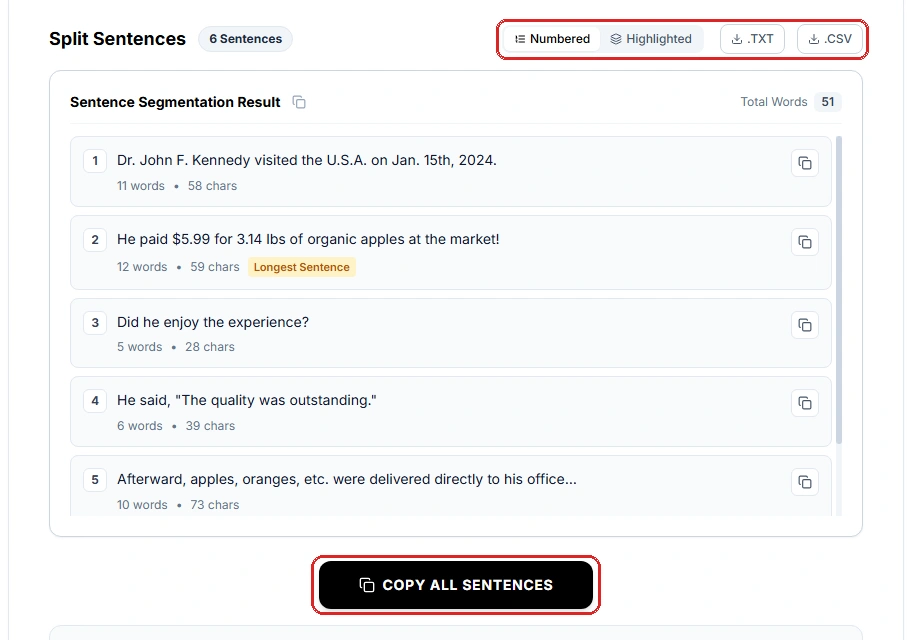
4. Copie ou Exporte
Copie tudo para a área de transferência ou baixe em arquivos CSV ou TXT.
Divisor de Frases Architecture and NLP Processing Pipeline
Nosso motor linguístico cumpre um fluxo estruturado de segmentação:
Blindagem de Tokens
Impede que pontos em e-mails, sites e decimais sejam interpretados como fim de frase.
Dicionário de Abreviaturas
Consulta mais de 70 títulos e abreviações corriqueiras para evitar quebras errôneas.
Vinculação de Citações
Mantém aspas e parênteses devidamente atrelados à respectiva frase.
Reconhecimento Multilíngue
Executa regras adaptadas à pontuação e ao alfabeto de cada idioma.
Linguistic Principles and Foundations of Divisor de Frases
Understanding the underlying grammatical mechanics and psycholinguistic research behind this utility empowers you to edit with precision:
Sentence Boundary Disambiguation (SBD) Mechanics
In computational linguistics, sentence boundary detection is not as trivial as breaking text at periods. Real-world prose contains periods inside honorifics (Dr., Prof.), numerical decimals (3.14159, $49.99), Latin expressions (e.g., i.e., et al.), domain names, and ellipses. Our algorithm applies heuristic regex patterns and context lookarounds to isolate true terminal sentence markers while safeguarding internal periods.
Cognitive Ergonomics & Working Memory Capacity
Cognitive psychologist George Miller's classic research on working memory capacity demonstrates that humans process information in chunks of 5 to 9 elements. When a single sentence spans 60 or 80 words with multiple embedded relative clauses, readers suffer cognitive overload and lose track of the core subject. Segmenting text line by line allows readers to absorb one complete semantic proposition before moving to the next.
Multi-Language Typography & Complex Punctuation Handling
Punctuation conventions vary widely across global languages. Spanish incorporates inverted interrogation and exclamation marks (¿, ¡), Greek uses the semicolon (;) as a question mark, and East Asian scripts employ the ideographic full stop (。). Our engine accommodates these distinct orthographic rules, enabling cross-linguistic parsing without typographic distortion.
Data Preparation for Machine Translation & CAT Ingestion
Modern computer-assisted translation (CAT) tools, neural translation models, and text-to-speech engines operate on sentence-level translation units (translation memory segments). Feeding unsplit paragraphs into translation memory software causes alignment mismatch errors. Segmenting text into clean sentence units maximizes translation memory matches and accelerates localization workflows.
Real-World Case Studies and Sentence Transformations
Examine before-and-after transformations across three distinct writing genres to observe practical editorial refinements in action:
Academic Literature Review
"The initial clinical trials yielded promising results regarding biomarker suppression, however subsequent replications conducted across diverse demographic cohorts failed to establish statistically significant outcomes, which prompted the primary investigators to reevaluate the foundational pharmacological hypothesis."
Diagnostic Critique: Three major scientific developments are crammed into a single 44-word sentence with comma splices, making it difficult for peer reviewers to evaluate each claim independently.
The initial clinical trials yielded promising results regarding biomarker suppression. However, subsequent replications across diverse demographic cohorts failed to establish statistically significant outcomes. Consequently, the primary investigators reevaluated the foundational pharmacological hypothesis.
Editorial Takeaway: Segmenting each empirical phase into its own sentence creates clear chronological and logical boundaries that strengthen scholarly arguments.
Corporate Executive Briefing
"Our third-quarter supply chain logistics suffered substantial delays due to port congestion and customs backlogs which resulted in a 14% drop in fulfillment velocity and client satisfaction ratings declined correspondingly across regional branches."
Diagnostic Critique: Multiple distinct business metrics (logistics causes, fulfillment drops, and client ratings) are strung together without pause, reducing urgency and executive clarity.
Our third-quarter supply chain logistics suffered substantial delays due to port congestion and customs backlogs. These bottlenecks caused a 14% drop in order fulfillment velocity. Client satisfaction ratings declined correspondingly across regional branches.
Editorial Takeaway: Executive stakeholders need immediate, scannable insights. Line-by-line separation ensures critical performance metrics cannot be overlooked.
Web Article & Digital Content
"Learning a new programming language requires daily deliberate practice and building real-world projects is much more effective than watching video tutorials because hands-on coding forces your brain to debug errors in real time."
Diagnostic Critique: A continuous run-on sentence that tires the reader on mobile screens where paragraph blocks become overwhelming walls of text.
Learning a new programming language requires daily deliberate practice. Building real-world projects is far more effective than passively watching video tutorials. Hands-on coding forces your brain to diagnose and debug errors in real time.
Editorial Takeaway: Short, discrete sentences enhance mobile reading scannability and dramatically decrease bounce rates.
Common Editorial Mistakes and Traps to Avoid
Even experienced authors can fall into subtle revision traps when restructuring sentences. Keep these precautions in mind:
Over-Fragmenting Complex Rhetorical Arguments
While short sentences boost clarity, cutting every single compound sentence into fragments can destroy nuance. Subordinate clauses that qualify an argument (e.g., 'unless', 'although') should remain connected to their main clause.
Losing Cohesive Transition Words
When splitting paragraphs, ensure transitional adverbs like 'However', 'Furthermore', or 'Consequently' are capitalized and properly punctuated so that the argumentative flow remains seamless across line breaks.
Ignoring Genre-Specific Formatting Norms
Dialogue, poetry, legal statutes, and mathematical proofs have distinct typographic conventions. Avoid applying uniform sentence splitting to formats that rely on specialized line-break styling.
Skipping the Final Holistic Read-Through
After segmenting text, read the entire piece from start to finish to confirm that the pacing feels musical and natural, rather than like an uncurated bulleted checklist.
Editorial Integration: How Divisor de Frases Fits Into Your Writing Pipeline
High-impact writing is achieved by combining structural, grammatical, and stylistic editing passes. Here is how professional copyeditors combine Divisor de Frases with complementary tools in the suite:
Pairing with the Sentence Splitter
Before fine-tuning grammar or tone, run long paragraphs through the Sentence Splitter. Isolating individual sentences on separate lines makes it easy to spot run-on clauses, excessive modifier stacks, and logical gaps across paragraphs.
Pairing with the Run-On Sentence Checker
Syntactic integrity is paramount. Combining Divisor de Frases with the Run-On Checker ensures that compound structures and spliced clauses are resolved with legitimate punctuation (semicolons, coordinating conjunctions, or periods) before trimming wordiness.
Pairing with the Sentence Shortener
After establishing correct clause boundaries, feed dense segments to the Sentence Shortener. Pruning conversational filler phrases, nominalizations, and pleonasms creates punchy prose that respects the reader's attention.
Pairing with the Passive to Active Converter
Injecting active voice creates energetic, responsible prose. Converting sluggish passive verbs into direct Subject-Verb-Object sequences guarantees that your core message conveys authority and clear ownership.
Final Polish with the Sentence Simplifier
Complete your editorial workflow with the AI Sentence Simplifier. Replace stubborn bureaucratic jargon or academic obscurities with crisp, universally accessible vocabulary that resonates across international audiences.
The Comprehensive Result
Layering these targeted utilities systematically removes cognitive friction. Your writing becomes clear, grammatical, concise, and immediately engaging across both digital displays and printed publications.
Professional Writing Advice: Dicas para uma Boa Estrutura de Frases
Uma Ideia por Frase
Concentre cada frase em uma ideia principal para facilitar a compreensão.
Varie o Tamanho
Mescle períodos curtos e impactantes com frases médias para criar ritmo.
Use Conectivos Claros
Conecte as orações com termos de transição como 'contudo', 'portanto' ou 'além disso'.
Faça Leitura em Voz Alta
Se você perder o fôlego antes de chegar ao ponto, divida a frase em duas partes.
Complementary Utilities in the Writing Suite
Chain these modular browser tools together to achieve comprehensive structural, grammatical, and stylistic refinement: