
Какво е слепено изречение (run-on sentence)?
Слепено изречение се получава, когато две или повече прости изречения се свържат без правилен пунктуационен знак или подходящ съюз.
Тези грешки затрудняват четенето и карат читателя да губи нишката на мисълта сред непрекъснати сказуеми.
Защо да поправяме слепените изречения? — Key Capabilities
Правилната пунктуация определя качеството и авторитета на вашия текст:
01Граматична коректност
Елиминирайте основни синтактични грешки в статии, есета и доклади.
02Плавен ритъм на четене
Точните точки и запетаи дават естествен въздух на всяка мисъл.
03Яснота на посланието
Предотвратете двусмислици, породени от липса на граници между изреченията.
04Готови предложения
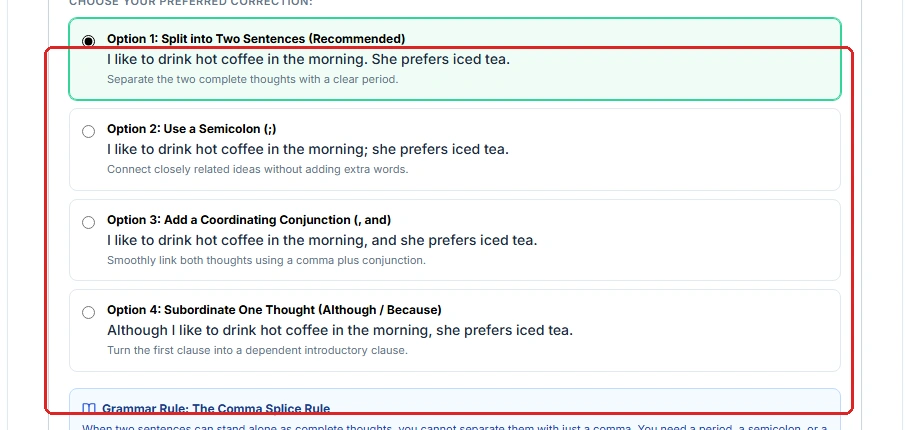
Получавате варианти за разделяне с точка, точка и запетая или съюз.
How to Use Проверка на изречения (Run-On Checker) Step-by-Step
Диагностицирайте и поправете синтактичните грешки лесно:
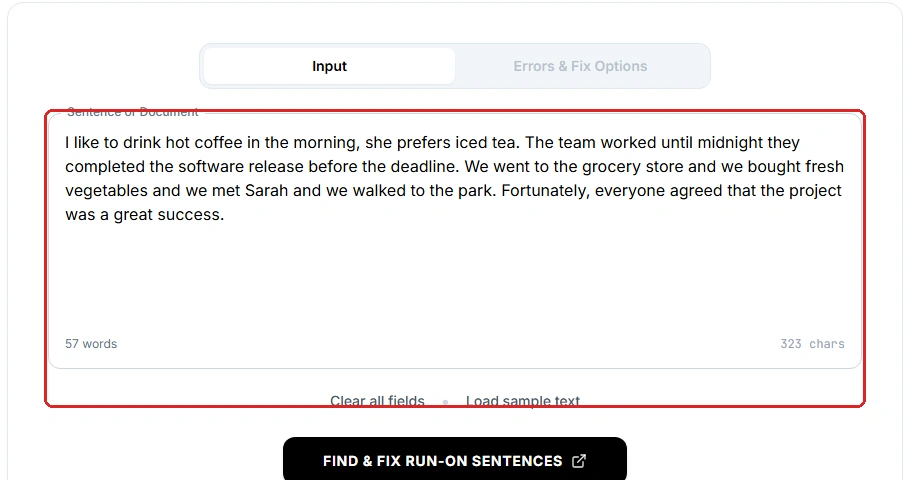
1. Поставете текста
Въведете абзаца в полето за проверка.
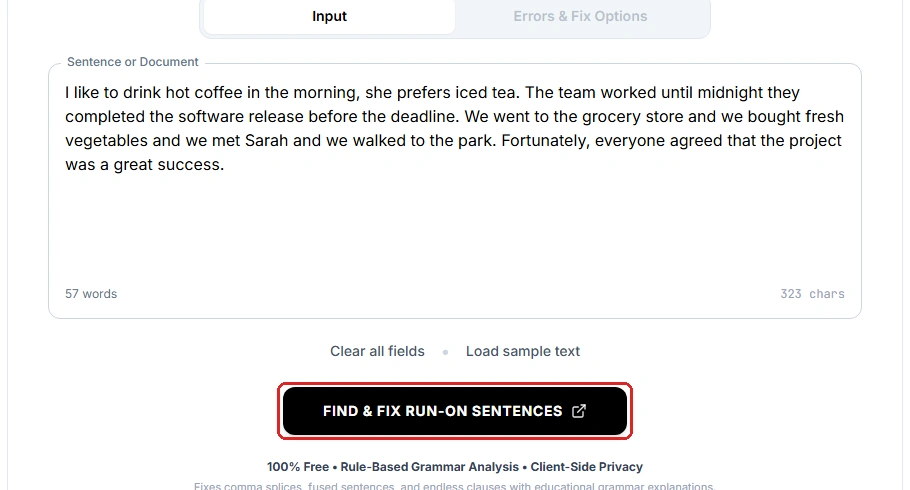
2. Стартирайте анализа
Кликнете бутона Провери изреченията.
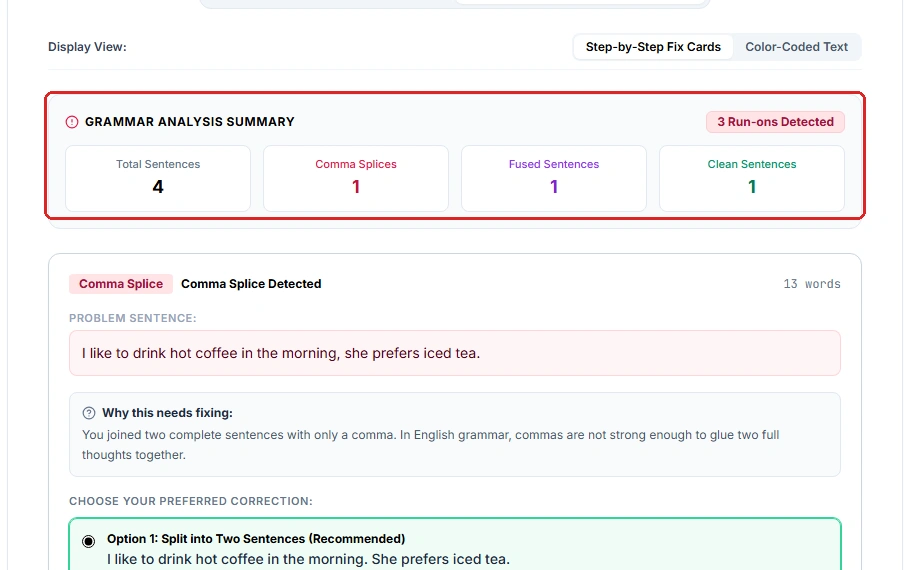
3. Прегледайте предложенията
Вижте подчертаните проблемни зони и изберете вариант за поправка.
4. Приложете корекцията
Копирайте изчистения текст в готовия си документ.
Проверка на изречения (Run-On Checker) Architecture and NLP Processing Pipeline
Алгоритъмът изследва връзките между отделните глаголи в изречението:
Откриване на сказуеми
Намира личните глаголни форми в изследвания откъс.
Проверка на съюзите
Следи за наличието на съчинителни и подчинителни съюзи между частите.
Анализ на препинателните знаци
Оценява дали запетаите и точките разделят коректно отделните мисли.
Формиране на решение
Генерира предложения за разделяне на самостоятелни изречения.
Linguistic Principles and Foundations of Проверка на изречения (Run-On Checker)
Understanding the underlying grammatical mechanics and psycholinguistic research behind this utility empowers you to edit with precision:
Clause Anatomy: Independent Clauses vs. Subordinate Structures
An independent clause contains a subject, a finite verb, and expresses a complete, freestanding thought. Run-on sentences occur when writers attempt to join two or more independent clauses without the appropriate grammatical glue. Understanding the distinction between independent clauses and dependent subordinate clauses is the key to mastering English syntax.
The Mechanics of Comma Splices vs. Fused Sentences
A comma splice occurs when two complete sentences are linked solely with a comma ('The experimental results were conclusive, the team submitted the paper'). A fused sentence merges two complete thoughts with zero punctuation whatsoever ('The team submitted the paper the editors were impressed'). Both errors disrupt reading flow and create syntactic disorientation for the reader.
The Four Standard Grammatical Remedies
Grammarians recognize four standard methods to resolve run-on errors: (1) Full stop separation: divide into two discrete sentences; (2) Semicolon linkage: join closely related thoughts with a semicolon; (3) Coordinating conjunctions: connect using a comma paired with one of the FANBOYS conjunctions (For, And, Nor, But, Or, Yet, So); or (4) Subordination: transform one clause into a dependent modifier using words like 'although', 'because', or 'while'.
Syntactic Variety and Reading Cadence
Fixing run-ons should not result in a monotonous string of short, choppy sentences. Skilful writers alternate between simple sentences (one independent clause), compound sentences (two coordinated clauses), and complex sentences (independent plus dependent clauses) to produce an engaging, musical reading cadence.
Real-World Case Studies and Sentence Transformations
Examine before-and-after transformations across three distinct writing genres to observe practical editorial refinements in action:
Academic Research Thesis
"The algorithm achieved 98.4% classification accuracy on the benchmark dataset, the training duration was reduced by nearly half compared to baseline convolutional architectures."
Diagnostic Critique: Classic comma splice: two full independent clauses joined with only a comma, creating grammatical dissonance in a high-stakes peer-reviewed submission.
The algorithm achieved 98.4% classification accuracy on the benchmark dataset. Furthermore, the training duration was reduced by nearly half compared to baseline convolutional architectures.
Editorial Takeaway: Separating into two sentences or inserting a transitional adverb with a semicolon immediately restores academic credibility.
Corporate Operating Policy
"All staff members must complete cybersecurity compliance training by Friday failure to do so will result in temporary suspension of internal system access privileges."
Diagnostic Critique: Fused sentence error: two distinct policy directives merged with zero punctuation, potentially creating legal or operational misunderstandings.
All staff members must complete cybersecurity compliance training by Friday; failure to do so will result in temporary suspension of internal system access privileges.
Editorial Takeaway: A semicolon or period clearly separates the mandate from the consequence, establishing airtight policy documentation.
College Admissions Essay
"I spent three months volunteering at the local wildlife rehabilitation sanctuary, I realized that my true calling lay in veterinary medicine and ecological conservation."
Diagnostic Critique: Comma splice linking a personal narrative cause with a pivotal career revelation, dampening the emotional impact of the admissions essay.
After spending three months volunteering at the local wildlife rehabilitation sanctuary, I realized that my true calling lay in veterinary medicine and ecological conservation.
Editorial Takeaway: Transforming the first clause into a subordinating dependent phrase creates sophisticated sentence hierarchy that impresses admissions reviewers.
Common Editorial Mistakes and Traps to Avoid
Even experienced authors can fall into subtle revision traps when restructuring sentences. Keep these precautions in mind:
Defaulting Exclusively to Periods and Creating Choppiness
Do not resolve every comma splice by blindly inserting a period. Over-relying on periods produces monotonous, staccato prose. Experiment with semicolons and subordinating conjunctions to maintain intellectual flow.
Overusing the Semicolon
The semicolon is a sophisticated punctuation mark, but peppering every paragraph with semicolons feels pretentious and heavy. Reserve semicolons for independent clauses with tightly coupled thematic contrast.
Confusing Conjunctive Adverbs with Conjunctions
Words like 'however', 'therefore', 'moreover', and 'consequently' are conjunctive adverbs, not coordinating conjunctions. Joining two independent clauses with 'however' still requires a semicolon or period (e.g., '; however, ').
Neglecting the Comma in Compound Sentences
When joining two independent clauses with a coordinating conjunction (FANBOYS: for, and, nor, but, or, yet, so), a comma must precede the conjunction. Omitting the comma creates a subtle run-on error.
Editorial Integration: How Проверка на изречения (Run-On Checker) Fits Into Your Writing Pipeline
High-impact writing is achieved by combining structural, grammatical, and stylistic editing passes. Here is how professional copyeditors combine Проверка на изречения (Run-On Checker) with complementary tools in the suite:
Pairing with the Sentence Splitter
Before fine-tuning grammar or tone, run long paragraphs through the Sentence Splitter. Isolating individual sentences on separate lines makes it easy to spot run-on clauses, excessive modifier stacks, and logical gaps across paragraphs.
Pairing with the Run-On Sentence Checker
Syntactic integrity is paramount. Combining Проверка на изречения (Run-On Checker) with the Run-On Checker ensures that compound structures and spliced clauses are resolved with legitimate punctuation (semicolons, coordinating conjunctions, or periods) before trimming wordiness.
Pairing with the Sentence Shortener
After establishing correct clause boundaries, feed dense segments to the Sentence Shortener. Pruning conversational filler phrases, nominalizations, and pleonasms creates punchy prose that respects the reader's attention.
Pairing with the Passive to Active Converter
Injecting active voice creates energetic, responsible prose. Converting sluggish passive verbs into direct Subject-Verb-Object sequences guarantees that your core message conveys authority and clear ownership.
Final Polish with the Sentence Simplifier
Complete your editorial workflow with the AI Sentence Simplifier. Replace stubborn bureaucratic jargon or academic obscurities with crisp, universally accessible vocabulary that resonates across international audiences.
The Comprehensive Result
Layering these targeted utilities systematically removes cognitive friction. Your writing becomes clear, grammatical, concise, and immediately engaging across both digital displays and printed publications.
Professional Writing Advice: Как да избягвате слепени изречения
Поставяйте точка при нова мисъл
Когато преминавате към отделен факт, завършете предишното изречение.
Използвайте точка и запетая
Тя свързва отлично две тясно свързани по смисъл независими изречения.
Не забравяйте съюзите
Свързвайте съставните изречения с ясни съюзи ('защото', 'въпреки че').
Внимавайте с дългите изброявания
Натрупването на части след запетая често води до объркване.
Complementary Utilities in the Writing Suite
Chain these modular browser tools together to achieve comprehensive structural, grammatical, and stylistic refinement: